1 The biggest stories of all
“In the beginning the Universe was created. This has made a lot of people very angry and been widely regarded as a bad move.” Douglas Adams, The Hitchhiker’s Guide to the Galaxy
We’re about to follow two big stories — chapters in the biggest story of all: how the universe began. The plot still has twists we’re unraveling. Surprises await.
Of course, the details are where the devil lives and they are fiercely complex. Two scientific communities battle with nature from opposite directions. The “outside” crew — astronomers and astrophysicists — look out, characterizing the constituents and nature of the cosmos. The “inside” crew — particle physicists, including me — look in, mimicking the earliest picoseconds of the universe by recreating its incredibly hot, adolescent conditions in laboratories here on the Earth. QS&BB is the story of both.
2 What’s the smallest thing we can know about?
2.1 The inside for my grandparents.
For my grandparents’ generation — children at the dawn of the 20th century — the sophisticated answer was “what you can see.” If you couldn’t see it, it wasn’t real. Chemists talked about atoms but treated them as a useful fiction, not real objects; physicists were even less flexible.
2.2 The inside for my parents.
For my parents’ generation, the answer was “protons, neutrons, and electrons.” The atom had become believable around the turn of the century and was refined over the next two decades — but for many, the neat planetary picture is where it stopped.
2.3 The inside …for us!
In our generation, the answer is “quarks and leptons” — and we’d be surprised if they turn out to be the end of the story. We’re hard at work, even as we speak with brand new tools to explore further than ever before.
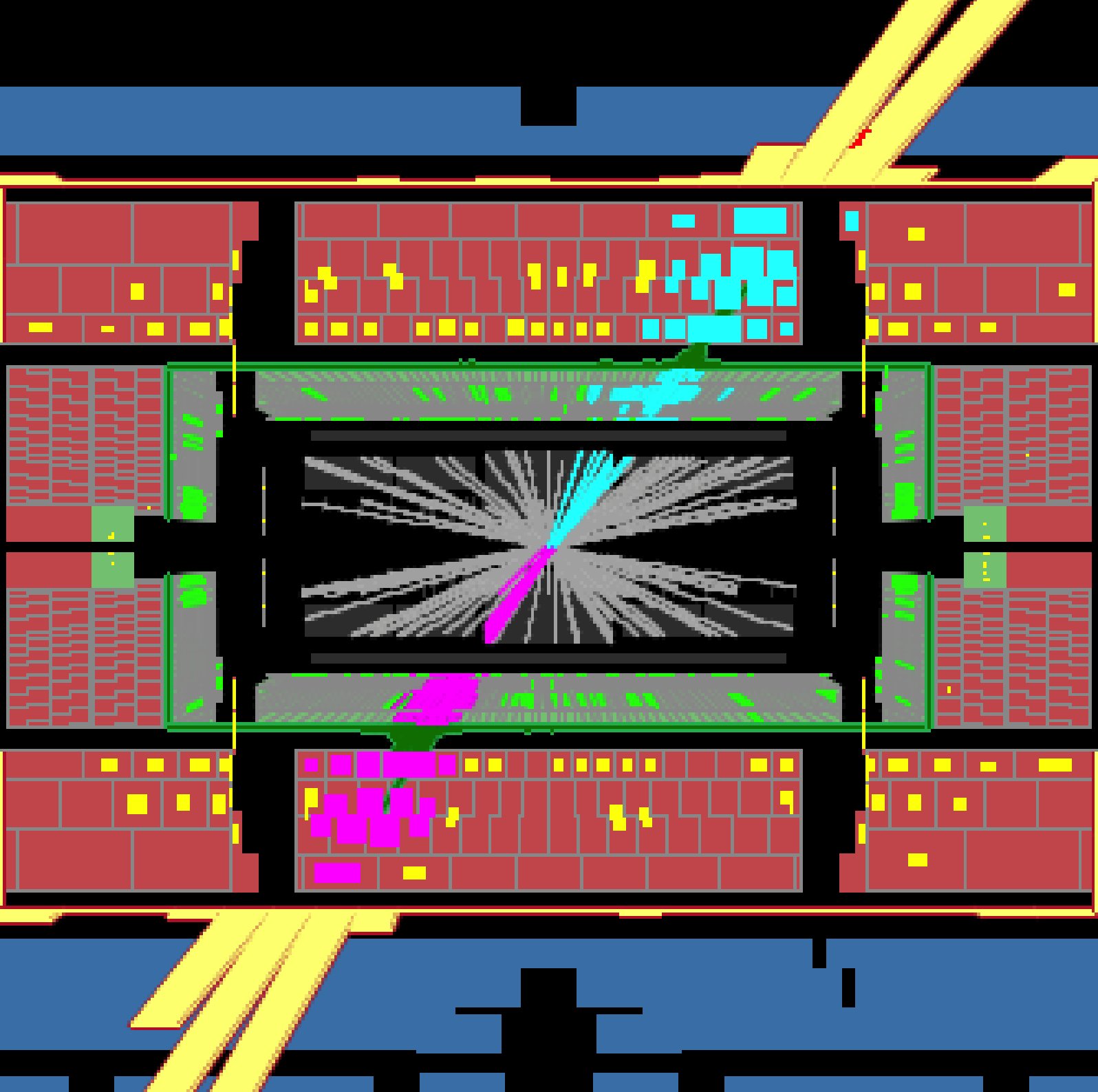
Decades of intense experimentation and imaginative theorizing, have revealed the tiniest bits of reality to be a fascinating collection of objects. In the 1950s and 1960s, we just stood back and tried to catch the hundreds of particles that our experiments spit out at us. New particles every year! Names that nobody could remember. Hundreds of them, which was ludicrous! Didn’t nature have some plan?
“Quarks”? Lots of jargon ahead — I’ll keep it straight as we go. For now: quarks are tiny pieces of the proton; leptons include the electron. Candidates for future discovery include extra quarks, the Higgs Boson, supersymmetric particles, WIMPs, and dark matter. But nature loves to surprise us, so we hold our expectations loosely.
The good news is that we’ve uncovered a model that knits that earlier mess together into a coherent picture of the entities themselves as well as the rules that govern how that stuff behaves. But we’re unhappy ☹️. Our grand synthesis of the Tiniest Bits Story—called the Standard Model (SM) — needs some polishing. Or more! While it’s been the paradigm of the successful scientific theory, we expect that new tiny bits are lurking in our experiments and we will be astonished if nothing shows up as we dig deeper. This new anticipation would have been met with blank stares only a couple of decades ago. There are mathematical problems with the SM. But. We also have experiments that violate the Standard Model: the spooky particle called “neutrinos” have masses but in the SM should be massless. So we are proud of the SM success and confused at the same time!
2.4 The inside for you?
Maybe in your generation? The sky’s the limit! We’ve hints at solving some old puzzles and we’ll undoubtedly find new ones with amazing new instruments and theoretical ideas which now rub shoulders with not just nature, but philosophy and the deepest questions asked by humans. Your generation is going to see amazing things.
So much for the inside effort.
3 Okay. So what’s the biggest real thing you can know about?
3.1 The outside for my grandparents.
For my grandparents’ generation, the universe was “the size of the Milky Way” — one cozy cluster of stars, densest toward the southern sky. It was also thought permanent: static, unchanging, built from just three kinds of objects — planets, stars, and star clusters, distinguished by their twinkle, brightness, and fuzziness. Sure, they all moved with regularity during each night and shifted slightly in a year, but the large scale structure of my grandparents’ universe was simple: a nice, intimate, dependable universe.
3.2 The outside for my parents.
For my parents’ generation, the universe suddenly became huge: those fuzzy clusters turned out to be other galaxies, far beyond our own. They learned of thousands — we now know billions — making the Milky Way a modest, ordinary example.
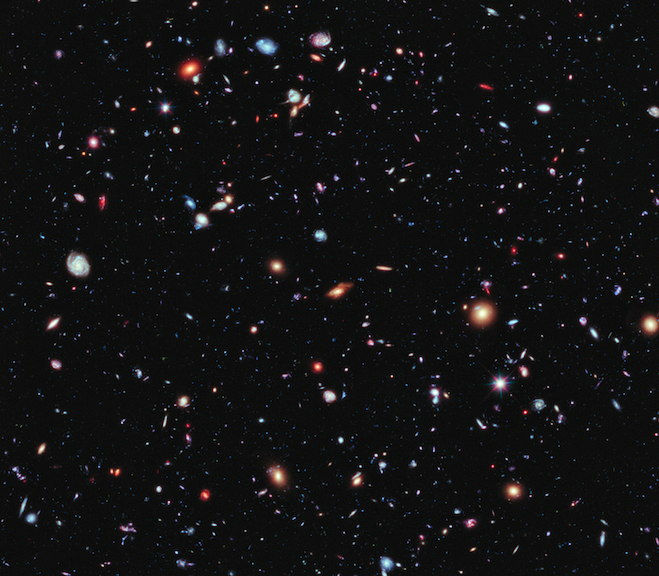
In this remarkable galactic family photograph the youngest galaxy imaged is 13.2 billion years old. We see it as it was when its light left its surface, on the way to the Hubble’s camera. It’s also a time when the universe was much smaller than it is now. This picture is today’s answer to the “biggest thing” question.
3.3 The outside for us.
The real shocker: my grandparents’ static universe was overthrown. It’s not only flying apart at breakneck speed — huge and reckless — it’s accelerating! We now see light from the very first galaxies. We see heavy objects using gravity waves — a new kind of astronomy! We measure the invisible, spooky “dark matter” surrounding galaxies, but can’t find it as quanta.
### The outside for you The unsettling news is that antiquity’s Big Questions are now legitimate research programs: Did the universe have a beginning? Are we alone? Will it end? Are there other universes? Was there anything before the beginning? What drives the acceleration? The outside crowd thinks big now — and only for the last couple of decades.
When I was in graduate school, a professor told me that Cosmology was “physics knitting.” Not any more! Cosmology in my and especially your generation is going to be flat-out amazing!
An Auspicious Beginning. Yes — the observable universe had a beginning, and quite a beginning: a roiling mess of radiation and particles at temperatures never seen since, with space, time, and all of energy confined to a human-size. Unthinkably dense, growing stunningly fast — it sounds like fiction, not science. And my generation explores it both ways: through telescopes and through particle collisions. That blend of outside and inside is what motivates me.
Wait. I don’t believe in the big bang. You appear to, but isn’t what you think just another “belief”? Aren’t we each entitled to our own beliefs?
Glad you asked. “Belief” is a tricky word that we all use, although in our context, we should be clear and I’ll try to do that in the next lesson.
4 The punchline!
QS&BB tells the interleaved stories of Particle Physics and Cosmology, blended into one narrative of how we came to be. We’re deep in the plot now — characters developed, a “can’t put it down” fever set in. I work on one big experiment, but dozens more, involving thousands of us worldwide — on the ground, in orbit, and deep underground — are pushing us toward the story’s climax.